See also
Saturday, May 23, 2015
Hiroshima, Nagasaki and the Big Historical Lie
Monday, June 01, 2015
'Mythology' of 1945 A-bombs
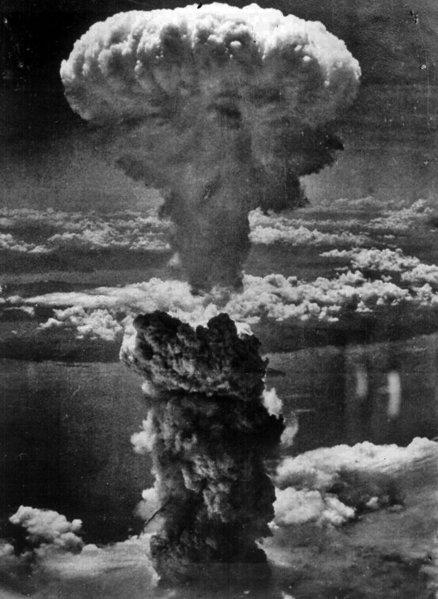
the US realism on the decision to use the atomic bombDid the nuclear bombings of Hiroshima and Nagasaki bring World War Two to an end?(Comfort Women and other lies about Japan)Atomic bombing of Nagasaki on August 9, 1945. The picture was taken from one of the B-29 Superfortresses used in the attack
See also
How Henry Stimson bombed Hiroshima, and Nagasaki too
by Stu Rosenblatt原爆投下と終戦◇Atomic Bombings 1945Hiroshima: the 'White Man's Bomb' revisited魚拓Just looking at the reaction of Smithsonian museum is good enough to convince me that
this is the sensitive issue.
I found another
discussion about Hiroshima going on at
Asian page .It seems some commenter got emotional.
Some argue that Japan would not have surrendered without atomic bombs, citing.
The view from Taiwan Others, such as Chaimaru, seem to argue that Truman could have acted otherwise, citing
HasegawaBut he also notes
Japan started the war, Japan committed war crimes Japan had also a plan to make atomic bombs and Japan should have surrendered earlier. There is no question about it
and
I don’t see any point in demanding apology or compensation however the mock tribunal trial reasoned and judged. and I don’t think Japanese people want apology or compensations at all..
I agree. This issue should not be used to accuse someone, some nation, but it should be studied for the future leaders who might face the decision.
Which view above is correct? Maybe both of them are right maybe not.
The following is an excerpt from
Prompt and Utter Destruction: President Truman and the Use of Atomic Bombs Against JapanI think this book is fair and balanced.I am sure you want to read the whole book.
page4 He[Truman} declared that the two available atomic bombs should be dropped on Japanese cities because "an invasion would cost at a minimum one quarter of a million casualties, and might cost as much as a million, on the American side alone "The president added that "a quarter of a million of the flower of young manhood was worth a couple of Japanese cities. Truman's statement brought the meeting to a close; none of the cabinet members or military officials present expressed a dissenting view......
p5 The meeting described never took place. T he quotation are authentic, but the context is not. With the exception of two notations from Truman's diary, the the statement quoted were made after the war to explain why the bomb was dropped. Those statements and many others expressing the same views created a widely held myth about the decision to use atomic bombs against Japan----the belief that Truman had to choose between, on the one hand, authorizing attacks on Japanese cities with atomic bombs, or, on the other hand ordering an invasion.
p5 I fact, however, Truman never face a categorical choice between the bomb and an invasion that would cost hundreds of thousands of American lives. T he prevailing perception about the alternative available to the president, which has become an article of faith among so many Americans,vastly oversimplifies the situation in the summer of 1945 as the Truman administration weighed its option for bringing the Pacific war to an end . The historical evidence makes clear that the popular view about the use of the bomb is a mythological construct for the following reason:(1)there were other options available for ending the war within a reasonably short time without the bomb and without invasion;(2)Truman and his key advisers believed that Japan was so weak that the war could end before an invasion began, that is, they did not regard an invasion inevitable;(3)even in the worst case ,if an invasion of Japan proved to be necessary, military planners in the summers of 1945 projected the number of the lives lost ar far fewer than the hundreds of thousands that Truman and his advisers claimed after the war.
p28 LeMay followed the attack by firebombing other major cities as well as returning to Tokyo with more raids. Although the Army Air Forces maintained an official position that they had not adopted a policy of area bombing that targeted civilian populations, the fire bombings of Japanese cities clearly demonstrated that attacks on the noncombatants were neither unplanned nor operationally inadvertent. They were intended to shorten the way by destroying not only the factories that gave the Japanese that means to continue fighting but also to sabotage morale that gave them the will to continue fighting
p30 The recognition that Japan was on the verge of defeat did not mean however, that it was on the verge of surrender.
p33 By the end of June 1945,it had been apparent for some time to both American and Japanese leaders that the outcome of the war would be certain defeat fro Japan
p37The June 18 meeting was a critical step in planning fro future actions o force a Japanese surrender and in highlighting the opinions, and assumptions and, concerns of key American policy makers.....The president and his top lieutenants recognized that Japan was nearing collapse, but they remained uncertain of the best way to achieve an early surrender.
p38 Thus in committee's opinion, t he phase of he invasion of Japan would cost about 46,000 American deaths and other 174,000 wounded and missing.
Marchall was convinced that the invasion of Kyusyu, rather than sole reliance on bombing and the blockade, was the best way to achieve an early Japanese surrender.
p39 MacArther who was anxious to lead the invasion of Kyusyu,,wired back that the estimate was "purely academic" and that he anticipated a smaller number of casualties.
p41The second possible alternative to an invasion stirred little debate among U.S. military planners or policymakers. This alternative was to wait fro the Soviet Union to enter the war against Japan.
Soviet entry into the war would be advantageous for the war effort, but the benefits would come at a cost from a diplomatic perspective. It would expand Soviet presence, power, and influence in China and other parts of Asia, which was not a welcome prospect at a time when tensions between the United State and Soviet Union were increasing over contentious issues in Europe
p42 Another possible alternative to an invasion received the attention and support within the Truman administration. It was mitigate the American demand for unconditional surrender by allowing the Japanese to retain the institution of the emperor
In the spring of 1945, a growing number of American policy makers favored a modification or clarification of the unconditional surrender policy because they feared it prolong the war.
page 45 Stimson, despite his support for offering Japan the opportunity to keep the emperor, opposed an immediate statement to that effect for fear of strengthening the position of the militants.
Military leaders seems even more concerned about how moderating unconditional surrender might affect public support for the war in the United State.
p47He[Truman] was torn between differing views. On the one hand, virtually all of his key advisers backed the modification of unconditional surrender .....On the other hand ,such action carried substantial risks---it could strengthen the position of the Japanese militarists, undermine morale at home and create significant political hazards for the president.
p50 There was, however , a fourth alternative that might ease the president's dilemma---the atomic bomb. If the bomb worked it provided a possible means to speed the end of the war without an invasion and without taking risks that reduced the appeal of the other options.
p61 The atomic attack on Hiroshima would not be confined to military
targets any more than the firebombings of other cities had been. Truman's dairy notation is attributable ,as historian Barton J Bernstein has suggest, only to self-deception.
Five fundamental considerations all of which grew out of circumstances that existed in the summer of 1945, moved Truman to use the bombs immediately , without great deal of thought and without consulting with his advisers about the advantages and potential disadvantages of the new weapons;(1)the commitment to ending the war successfully at the earliest possible moment:(2)the need to justify the effort and expense of building the atomic bomb;(3)the hope of achieving diplomatic gains in the growing rivalry with the Soviet Union;(4)the lack of incentives not to use atomic weapons;and (5)hatred of the Japanese and a desire for vengeance.
by the late 1980's specialist who studied the available evidence reached a broad, though hardly unanimous, consensus on some key issues surrounding the use of the bomb. One point of agreement was that Truman and his advisers were well aware of alternatives to the bomb that seemed likely but not certain, to end the war within a relatively short time. Another was that an invasion of Japan would probably not have been necessary to achieve victory.A third point of general agreement in the scholary literature on the decision to use the bomb was that the postwar claims that the bomb prevented hundreds of thousands of Americans combat death could not be sustained with the available evidence. Most of students of the subject also concurred that political considerations figured in the deliberations about the implications of the bombs and the end of the war with Japan. On all of those poionts, the scholarly consensus rejected the traditional view that bomb was the only alternative to an invasion of Japan that would cost a huge number of Americans lives, At the same time, most scholars supported the claim of Truman and his advisers that the primary motivation fro dropping atomic bombs o Hiroshima and Nagasaki was to end the war at the earliest possible moment----that is , for military reason.
p107In early 1995,the Smithsonian bowed to enormous and irresistable political pressure and drastically scaled back the planned exhibit.....The "fact" that the exhibit reported when it opened in June 1995 were largely innocuous descriptions of the plane and its resotratoin.but some statements were disputable asserstions about the use of the bomb,assersions that were highly interpretive.One label,for example, declared that the use of atomic bombs "made unnecesary the planned invasion of the Japanese home islands." and that "such invasion would have led to very heaby casualities among Americans,Allied and Japanese armed forces,and Japanese civilians.
p108The most important issues that cannot be fully settled becauss they require speculation and extrapolation from available evidence include (1) how long the war would have continued if the bomb had not been used;(2)how many casuality American forces would have suffered if the bomb had no been dropped;(3)whether an invasion would have been necessary without the use of the bomb;invasion would have been necessary without the use of the bomb;(4)the number of American lives and casualities an invasion would have exacted had it proved necessary;(5)whether Japan would have responded favourly to an American officer to allow the emperor to remain on the throne before Hiroshima, or whether any of the other would have prolonged the war:and (6)whether any of the other alternatives to the use of the bomb would have ended the war as quickly on a basis satisfactory to the United States.
...................................................................................
I think the book shows some good points the future leader must take into account and what she should not take into account.
Here are some points I can think of .
To make the enemy surrender as quick as possible is not the good justification for using atomic bombs.
To make the enemy surrender based on fancy calculations about the casualities on our side is not a good justification for using atomic bombs.
If these justify the use of atomic bombs, it is better to nuke North Korean to save
a million of North koreans who are starving now.But other considerations must be taken into account.
In particular,the future leader must take the innocent lives that must be sacrificed seriously.
And the future leader should not take into his own popularity when the alternative is the atomic bombs.
The future leaders should give several warnings to see if they moves toward conciliation.Only after possible alternatives failed, probably she is justfied in using it.
BTW there was a warning in the form of leaflet before nuking Nagasaki but it seems there was no warning I am not sure.If somebody knows,let me know.
The Nagasaki Principle/Japan probeAnd for youre reference,
Documents on the decision to use the atomic bomb..................................................................................
Would Japan have surrendered before November 1 on the basis of the atomic bomb alone, without the Soviet entry into the war?
The two bombs alone would most likely not have prompted the Japanese to surrender, so long as they still had hope hat Moscow would mediate peace.....Anami's warning that the United States might have 100 atomic bombs and that the next target might be Tokyo had no discernible impact on he debate. Even after Nagasaki bomb, Japan would most likely have still waited for Moscow's answer to the Konoe mission......
{Frank] emphasizes especially the importance of Hirohito's statement....
The Imperial Rescript on August 15 does refer to the use of the "cruel new bomb. as one of the reasons for the termination of the war, with no mention of Soviet entry into the war. .....In contemporary records from August 6 to August 15 two sources (the imperial Rescript on August 15 and Suzuki's statement at the August 13 cabinet meeting) refer only to the impact of the atomic bomb, three sources only to Soviet entry(Konoe on August 9. Suzuki's statement to his doctor on August 13, and the Imperial rescript to Soldiers and Officers on August 17), and seven sources both to the atomic boom and Soviet Involvement. Contemporary evidence does not support Frank's contention.
page 295 Racing the enemy Hasegawa
,,,,,,,,,,,,,,,,,,,,,,,,,,,,,,,,,,,,,,,,,,,,,,,,,,,,,,,,,,,,,,,,,,,,,,,,,,,,,,,,,
Enola Gay: Was Using the Bomb Necessary?
by Gar Alperovitz
Tomorrow's opening by the Smithsonian Institution of an exhibit featuring the Enola Gay, the B-29 Superfortress that dropped the first atomic bomb on Hiroshima in 1945, has occasioned the protest of hundreds of prominent scholars, writers and religious leaders. The reason is that the plane is being put forward with no mention of the huge number of civilians killed at Hiroshima (and subsequently at Nagasaki), and no acknowledgment of the ongoing domestic and worldwide controversy over the use of the atomic bomb. Instead, Air and Space Museum Director General John ''Jack'' Dailey has put the emphasis elsewhere -- on the plane ``in all of its glory as a magnificent technological achievement.''
News of the century
In 1999, a distinguished group of journalists deemed the atomic bombing of Hiroshima and Nagasaki the most important news event of the 20th century. A recent poll found that more Americans age 30-39 disapprove than approve of the bombings by a margin of 50 percent to 45 percent -- with almost as many (49 percent to 46 percent) also disapproving in the 18-29 age group. One of the main reasons why controversy still persists after almost 60 years is that, contrary to the conventional wisdom, there is very little evidence that top U.S. military leaders at the time believed that the atomic bomb was needed to end the war without a costly invasion. Indeed, quite the opposite appears to be true.
Adm. William D. Leahy, President Truman's chief of staff and the man who presided over meetings of both the U.S. chiefs of staff and the combined U.S.-British chiefs of staff, minced few words. Seven weeks before Hiroshima, his diary shows that he believed that the war could be ended in a manner that achieved all U.S. security aims.
`This barbarous weapon'
In his memoirs, the conservative admiral wrote: ``[T]he use of this barbarous weapon at Hiroshima and Nagasaki was of no material assistance in our war against Japan. The Japanese were already defeated and ready to surrender. . . . [I]n being the first to use it, we . . . adopted an ethical standard common to the barbarians of the Dark Ages. I was not taught to make war in that fashion, and wars cannot be won by destroying women and children.''
Among the many other top World War II leaders who are on record as stating that the bomb was unnecessary are the commanding general of the U.S. Army Air Forces, Henry H. ''Hap'' Arnold; Fleet Adm. Chester W. Nimitz, commander-in-chief of the Pacific Fleet; Adm. William F. Halsey Jr., commander of the U.S. Third Fleet; and the famous ''hawk'' who commanded the 21st Bomber Command, Maj. Gen. Curtis E. LeMay. Army Chief of Staff Gen. George C. Marshall privately proposed that the bombs be dropped first on a military target such as a large naval base -- then, if that didn't work, that civilians be warned to leave before a city were targeted.
In his memoirs, President -- and former general -- Dwight D. Eisenhower reported the following reaction when Secretary of War Henry Stimson informed him that the atomic bomb would be used: ''During his recitation of the relevant facts, I had been conscious of a feeling of depression, and so I voiced to him my grave misgivings, first on the basis of my belief that Japan was already defeated and that dropping the bomb was completely unnecessary, and secondly because I thought that our country should avoid shocking world opinion by the use of a weapon whose employment was, I thought, no longer mandatory as a measure to save American lives.'' In a 1963 interview, he put it bluntly: ``[I] it wasn't necessary to hit them with that awful thing.''
Notwithstanding these and many related facts, writers who defend the atomic bombings claim that a fanatical Japanese military leadership would have fought on, no matter what. It is, of course, impossible ever to fully resolve the historical dispute, because the bombs were, in fact, used. However, the evidence that we have strongly indicates that the Japanese emperor would likely have ended the war without the use of the atomic bomb -- just as so many U.S. military leaders believed.
Top U.S. leaders were advised as early as April 1945 -- four months before the bombing -- that a combination of the forthcoming declaration of war by the Soviet Union (which occurred almost simultaneously with the bombings) plus a clarification of the surrender terms for the emperor would almost certainly have brought an end to the fighting. With three months still to go before the November invasion could begin, the bomb could have been used if the shock of the Red Army attack failed to produce the expected results. When the Japanese Army general staff issued a statement on surrender, it explained that the existence of the nation was threatened ''as a result of Russia's entrance into the war.'' No mention was made of the atomic bomb.
International law
There are also ongoing questions of morality and international law involved in the Truman administration's decision to sacrifice large numbers of civilians. Former Secretary of Defense Robert McNamara, who during World War II helped plan the bombing of Japanese cities as an aide to LeMay, recently observed that he and LeMay ''were behaving like war criminals.'' A prosecutor, McNamara says, would have argued that directly targeting cities was not proportional to our war aims, thus prohibited under international law. He quotes LeMay as stating explicitly: ``If we lose the war, we'll be tried as war criminals.''
An additional reason why the bombing is still controversial is that it was done in a way that minimized the possibility of what later came to be called ''arms-control'' measures. Instead of initiating some kind of ''confidence-building'' negotiation in advance with the Soviets (as many had advised at the time), a major goal was to demonstrate what Stimson called the ''master card'' of American diplomacy in as dramatic a way as possible.
The role of force
Obviously, the issues surrounding Hiroshima still bear on the role of force in foreign policy and on the possible future use of nuclear weapons. The Clinton administration explicitly threatened the possible use of nuclear weapons in Korea, and the Bush administration's policies in general -- to say nothing of its new more-aggressive nuclear posture -- open the clear possibility that such weapons will be used in questionable ways.
In light of these many considerations, however one judges the numerous still-debated issues concerning the bombing of Hiroshima, the Smithsonian as one of the nation's premier educational institutions had, and still has, an obligation to present all sides and all important aspects of the continuing controversy.
The Myth of Hiroshima
An atomic bomb was dropped without warning on the center of the Japanese city of Hiroshima.
One hundred and forty thousand humans were killed, more than 95% of them women, children and other noncombatants.
At least half of the victims died of radiation poisoning over the next few months.
Three days after Hiroshima was obliterated, the city of Nagasaki suffered a similar fate.
The magnitude of death was enormous. On August 14, 1945 - five days after the Nagasaki bombing - Radio Tokyo announced that the Japanese emperor had accepted the American terms for surrender.
To many Americans at the time, and still for many today, it seemed clear that the atomic bomb had ended the war, even "saving" a million lives that might have been lost if the Americans had been required to invade mainland Japan.
This powerful narrative took root quickly and is now deeply embedded in our historical sense of who we are as a nation justifying the greatest terroist attack, at this time, in human history.
In the mid-1990's, on the 50th anniversary of this terrorist attack, this narrative was reinforced in an exhibit at the Smithsonian Institution on the Enola Gay, the plane that dropped the first atomic bomb. The exhibit, the subject of a bruising political battle, presented to nearly 4 million Americans an officially sanctioned opinion of the atomic bombings that again portrayed them as a necessary act.
Although patriotically correct, the exhibit and the narrative on which it was based were historically inaccurate. For one thing, the Smithsonian downplayed the casualties, saying only that the atomic bombs "caused many tens of thousands of deaths" and that Hiroshima was "a definite military target."
Americans were also told that use of the atomic bombs "led to the immediate surrender of Japan and made unnecessary the planned invasion of the Japanese home islands."
The United Soviet Socialist Republic's entry into the Pacific war on August 8, two days after the Hiroshima atomic bombing, caused Japan's capitulation.
The Enola Gay exhibit also repeated such outright lies as the assertion that "special leaflets were dropped on Japanese cities" warning civilians to evacuate. The fact is that atomic bomb warning leaflets were dropped on Japanese cities, but only after Hiroshima and Nagasaki had been destroyed.
The hard truth is that the atomic bombing were unnecessary. A million lives were not saved. McGeorge Bundy, the man who first popularized this figure, later confessed that he had pulled it out of thin air in order to justify the bombings in a 1947 Harper's magazine essay he had ghostwritten for Secretary of War Henry L. Stimson.
The bomb was dropped, as J. Robert Oppenheimer, scientific director of the Manhattan Project, said in November 1945, on "an essentially defeated enemy."
Harry S. Truman used the atomic bombing primarily to prevent the Soviets from sharing in the occupation of Japan. Harry S. Truman used the atomic bomb on August 6. Harry S. Truman returned from the Potsdam Conference on August 3 believing that the Japanese were looking for peace.
Unpleasant historical facts were censored from the 1995 Smithsonian exhibit, an action that should trouble every American.
An officially sanctioned government opinion distorts history, democracy is threatened and the truth of reality is corrupted.
Today, in the post-9/ll era, it is critically important that Americans face the truth about the atomic bomb.
Mr. I. Michael Heyman
Secretary
The Smithsonian Institution
Washington, D.C. 20560
July 31, 1995
Dear Secretary Heyman:
Testifying before a House subcommittee on March 10, 1995, you promised that when you finally unveiled the Enola Gay exhibit, "I am just going to report the facts."[1]
Unfortunately, the Enola Gay exhibit contains a text which goes far beyond the facts. The critical label at the heart of the exhibit makes the following assertions:
* The atomic bombings of Hiroshima and Nagasaki "destroyed much of the two cities and caused many tens of thousands of deaths." This substantially understates the widely accepted figure that at least 200,000 men, women and children were killed at Hiroshima and Nagasaki. (Official Japanese records calculate a figure of more than 200,000 deaths--the vast majority of victims being women, children and elderly men.)[2]
* "However," claims the Smithsonian, "the use of the bombs led to the immediate surrender of Japan and made unnecessary the planned invasion of the Japanese home islands." Presented as fact, this sentence is actually a highly contentious interpretation. For example, an April 30, 1946 study by the War Department's Military Intelligence Division concluded, "The war would almost certainly have terminated when Russia entered the war against Japan."[3] (The Soviet entry into the war on August 8th is not even mentioned in the exhibit as a major factor in the Japanese surrender.) And it is also a fact that even after Hiroshima and Nagasaki were destroyed, the Japanese still insisted that Emperor Hirohito be allowed to remain emperor as a condition of surrender. Only when that assurance was given did the Japanese agree to surrender. This was precisely the clarification of surrender terms that many of Truman's own top advisors had urged on him in the months prior to Hiroshima. This, too, is a widely known fact.[4]
* The Smithsonian's label also takes the highly partisan view that, "It was thought highly unlikely that Japan, while in a very weakened military condition, would have surrendered unconditionally without such an invasion." Nowhere in the exhibit is this interpretation balanced by other views. Visitors to the exhibit will not learn that many U.S. leaders--including Gen. Dwight D. Eisenhower[5], Admiral William D. Leahy[6], War Secretary Henry L. Stimson[7], Acting Secretary of State Joseph C. Grew[8] and Assistant Secretary of War John J. McCloy[9]--thought it highly probable that the Japanese would surrender well before the earliest possible invasion, scheduled for November 1945. It is spurious to assert as fact that obliterating Hiroshima in August was needed to obviate an invasion in November. This is interpretation--the very thing you said would be banned from the exhibit.
* In yet another label, the Smithsonian asserts as fact that "Special leaflets were then dropped on Japanese cities three days before a bombing raid to warn civilians to evacuate." The very next sentence refers to the bombing of Hiroshima on August 6, 1945, implying that the civilian inhabitants of Hiroshima were given a warning. In fact, no evidence has ever been uncovered that leaflets warning of atomic attack were dropped on Hiroshima. Indeed, the decision of the Interim Committee was "that we could not give the Japanese any warning."[10]
* In a 16 minute video film in which the crew of the Enola Gay are allowed to speak at length about why they believe the atomic bombings were justified, pilot Col. Paul Tibbits asserts that Hiroshima was "definitely a military objective." Nowhere in the exhibit is this false assertion balanced by contrary information. Hiroshima was chosen as a target precisely because it had been very low on the previous spring's campaign of conventional bombing, and therefore was a pristine target on which to measure the destructive powers of the atomic bomb.[11] Defining Hiroshima as a "military" target is analogous to calling San Francisco a "military" target because it has a port and contains the Presidio. James Conant, a member of the Interim Committee that advised President Truman, defined the target for the bomb as a "vital war plant employing a large number of workers and closely surrounded by workers' houses."[12] There were indeed military factories in Hiroshima, but they lay on the outskirts of the city. Nevertheless, the Enola Gay bombardier's instructions were to target the bomb on the center of this civilian city.
The few words in the exhibit that attempt to provide some historical context for viewing the Enola Gay amount to a highly unbalanced and one-sided presentation of a largely discredited post-war justification of the atomic bombings.
Such errors of fact and such tendentious interpretation in the exhibit are no doubt partly the result of your decision earlier this year to take this exhibit out of the hands of professional curators and your own board of historical advisors. Accepting your stated concerns for accuracy, we trust that you will therefore adjust the exhibit, either to eliminate the highly contentious interpretations, or at the very least, balance them with other interpretations that can be easily drawn from the attached footnotes.
Sincerely,
The Atomic Bomb and the End of World War II
A Collection of Primary SourcesWhat Recent Scholarship Concludes About Hiroshima4. A-BOMB EXPERIMENTED IN ALAMOGORDO日本の原爆開発I told him I was busy considering our conduct of the war, against Japan and I told him how I was trying to hold the Air Force down to to precision bombing but that with the Japanese method of scattering its manufacture it was rather difficult to prevent the area bombing. I told him I was anxious about this feature of the war for two reason ;first , I didn't want to have the Untited States get the reputation in outdoing Hitler in atrocities. Second, I was little fearful we could get ready the airforce might have Japan so thoroughly bombed out that a new weapon would not have a fair background to show its strengh . He laughed and said he understood.Memorandum of Conference with the President, June 6, 1945, Top Secret
Source: Manuscripts and Archives, Yale University Library, Henry Lewis Stimson Papers (microfilm at Library of Congress)
Stimson


 Hanbando
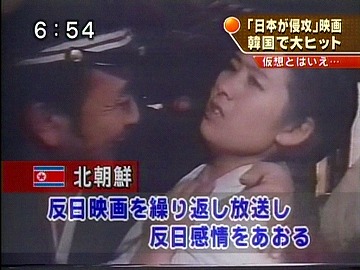 North Korea film
 A north Korean anti-american film with a south Korean anti-American song